

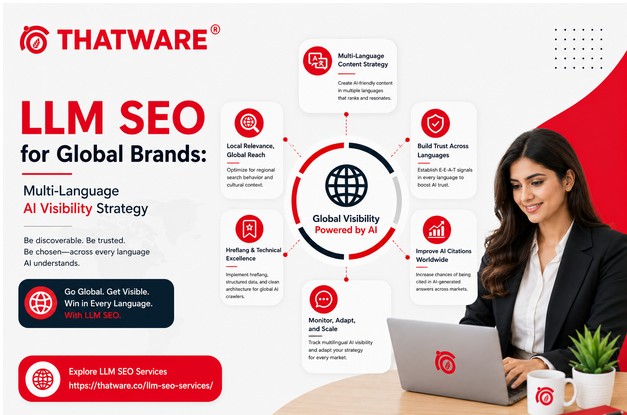
Running a global brand is already complicated. Multiple markets, multiple languages, varying regulatory environments, different competitive landscapes, culturally distinct customer expectations. Maintaining a coherent brand identity while adapting meaningfully to local contexts has been the challenge of international marketing for as long as brands have crossed borders.
LLM SEO adds a new layer to that complexity — and also, if handled correctly, a new opportunity. Because AI visibility isn’t just about ranking on Google anymore. It’s about how AI systems in different markets, trained on different language corpora, represent your brand to users asking questions in their own language.
A global brand that’s well-represented in English-language AI responses but invisible in German, Japanese, Portuguese, or Arabic AI responses is missing a growing portion of its potential market. And the strategies for building that multi-language AI visibility are different enough from English-market LLM SEO that they deserve their own framework.
How Language Affects AI Model Knowledge
Here’s something that surprises many marketers: AI models don’t simply translate knowledge across languages. A model trained on a multilingual corpus doesn’t have perfectly equivalent knowledge in every language. Its understanding of your brand in Spanish, for instance, reflects the Spanish-language content available about your brand — not a translation of its English-language understanding.
If you have extensive English-language coverage and documentation but thin Spanish-language web presence, an AI responding to a Spanish-language query may have a much less confident or less complete representation of your brand. It might get your category right but miss important product details. Or it might not mention you at all, defaulting to competitors with stronger Spanish-language documentation.
This matters enormously for global brands with significant markets in non-English-speaking regions. The work of building AI visibility needs to happen at the language level, not just the market level.
Localization vs. Translation: A Critical Distinction
For multi-language LLM SEO, the distinction between localization and translation is foundational. Translation — converting English content into another language — gives you content that exists in that language but doesn’t necessarily reflect how people in that market talk about, search for, or think about your product category.
Localization goes further: adapting the content to reflect local terminology, local industry frameworks, local competitive context, and local content norms. A German business audience engages with content differently than a Brazilian one. The questions they’re asking AI assistants use different vocabulary, frame problems differently, and operate within different industry reference frameworks.
For LLM visibility purposes, localized content is almost always more effective than translated content. AI models trained on German-language corpora are calibrated to the kinds of German-language content that German speakers produce and consume. Content that reads naturally and authoritatively in German — because it was created with a German-speaking audience and information environment in mind — performs better than content that reads like translated English.
Building Local Entity Signals in Each Market
Beyond content, local entity signals matter for multi-market LLM SEO. In each major market, your brand’s AI representation draws from local sources: local press coverage, local review platforms, local business directories, local community discussions, local industry associations.
A global brand serious about AI visibility in France, for example, needs to be documented in French-language sources — covered by French-language industry publications, listed in French business databases, engaged in French professional communities, reviewed on platforms French buyers consult. The English-language Wikipedia article about your company doesn’t fully compensate for absence in French-language information ecosystems.
Enterprise LLM optimization agency services designed for global brands need to operate with this market-by-market specificity. A one-size-fits-all approach to multi-market AI visibility simply doesn’t work because the information ecosystems feeding AI knowledge in each language market are genuinely distinct.
Priority Market Sequencing
Few global brands have the resources to build deep LLM visibility in every market simultaneously. Prioritization is essential.
The factors to weigh: market size and commercial importance, current AI adoption rates among your target customers in that market, the maturity of AI search infrastructure in that language (some languages have better AI coverage than others), the competitive landscape in that market’s AI-visible space, and the difficulty of building coverage in that language.
English, Spanish, German, French, Japanese, Portuguese, and Mandarin are generally the highest-priority language markets for global brands right now, both in terms of AI model coverage and commercial scale. Building sequentially through priority markets is more achievable and more effective than trying to address all markets at once.
The Translation Partner and Local Team Question
For brands without internal multilingual capabilities, building genuine local-language LLM visibility usually requires a combination of local partners and specialized support.
Local content creators who are native speakers and domain experts can produce the kind of genuinely credible, contextually appropriate content that drives AI citations in their language market. A German-speaking B2B marketing expert writing about your SaaS product for the German market will produce content that performs better with German-language AI models than a translated version of your English content.
Similarly, local PR relationships — connecting with journalists, analysts, and community voices in each market — produces the earned coverage that builds local AI authority. These relationships are generally built through people who are embedded in those markets, not managed remotely from a global headquarters.
LLM optimization agency near me thinking — the desire for a local partner who understands both the language and the market — reflects a genuine strategic insight for global brands. Market-embedded LLM SEO support produces better results than a fully centralized global approach, at least at the content and coverage level.
Monitoring AI Visibility Across Languages
One practical challenge with multi-market LLM SEO is measurement. You need to test AI responses in multiple languages, across multiple AI platforms (which don’t always have equivalent versions in every language), and interpret results in context.
Building a multilingual query testing framework requires identifying the specific questions your target customers in each market would ask AI assistants in their own language — and that requires genuine native-speaker knowledge, not just translation of your English query list. The terminology and framing of industry questions varies meaningfully across languages.
Establishing baseline metrics in each priority market, and tracking changes over time as your local-language LLM investments compound, gives you the measurement framework to understand what’s working and allocate resources accordingly.
Multi-language AI visibility isn’t a single initiative — it’s a sustained, market-by-market program. But for global brands with significant markets in non-English-speaking regions, it’s increasingly a competitive necessity rather than a nice-to-have.